AI for hotels and inns: automated bookings and check-in on WhatsApp
How small hotels and inns use AI agents on WhatsApp to answer availability, close bookings, and cut no-shows without staffing a 24-hour front desk.
On this page
- Why hospitality is a special support case
- What an AI agent actually handles
- How to build the automated booking flow
- Cutting no-shows and last-minute cancellations
- Dynamic rates: peak season, pricing, and real-time availability
- Common mistakes when automating hospitality
- Real example: an 18-room beach inn
- Metrics worth tracking
- One agent, the whole stay
Saturday, 11pm, a traveler messages a small inn asking if there’s a room open for next Friday. Nobody answers until Monday morning, and by then the traveler has already booked somewhere else. Hospitality runs on exactly this kind of last-minute decision, at any hour, and most small hotels and inns don’t staff a front desk at 11pm on a Saturday. That’s where an AI agent on WhatsApp stops being a nice-to-have and becomes basic operating infrastructure.
Why hospitality is a special support case
Restaurants concentrate traffic during meal-time peaks. Hospitality concentrates on a different axis: guests research and decide outside business hours, often during their own work day or late at night, comparing one property against another before booking. Add seasonality (weekends, holidays, peak season) on top, and the result is a message volume that ignores office hours completely.
That creates three specific leak points:
- An availability question that goes unanswered fast enough, so the traveler books with whichever competitor replied first.
- A confirmed reservation with no check-in confirmation, which turns into confusion (or a no-show) on arrival day.
- The same house-rules question over and over (check-in time, cancellation policy, pet policy, parking), eating up time from staff who should be focused on guests already on-site.
None of these three problems requires complex human judgment. They’re predictable questions, asked exactly when nobody on staff is on duty to answer.
There’s a hidden cost too: hotels and inns that depend only on OTAs (Booking, Airbnb, Expedia) pay a 15% to 20% commission per reservation. A direct booking through the property’s own WhatsApp is margin that stays with the owner, but it only works if someone (or something) can respond fast enough to compete with a two-tap OTA booking experience.
What an AI agent actually handles
An agent connected to the front desk’s WhatsApp covers the repetitive work and frees staff for what actually needs a human:
Availability and rates. A guest asks “do you have anything open the weekend of the 20th?” and gets an instant answer pulled from real property availability, not a spreadsheet nobody has updated in weeks.
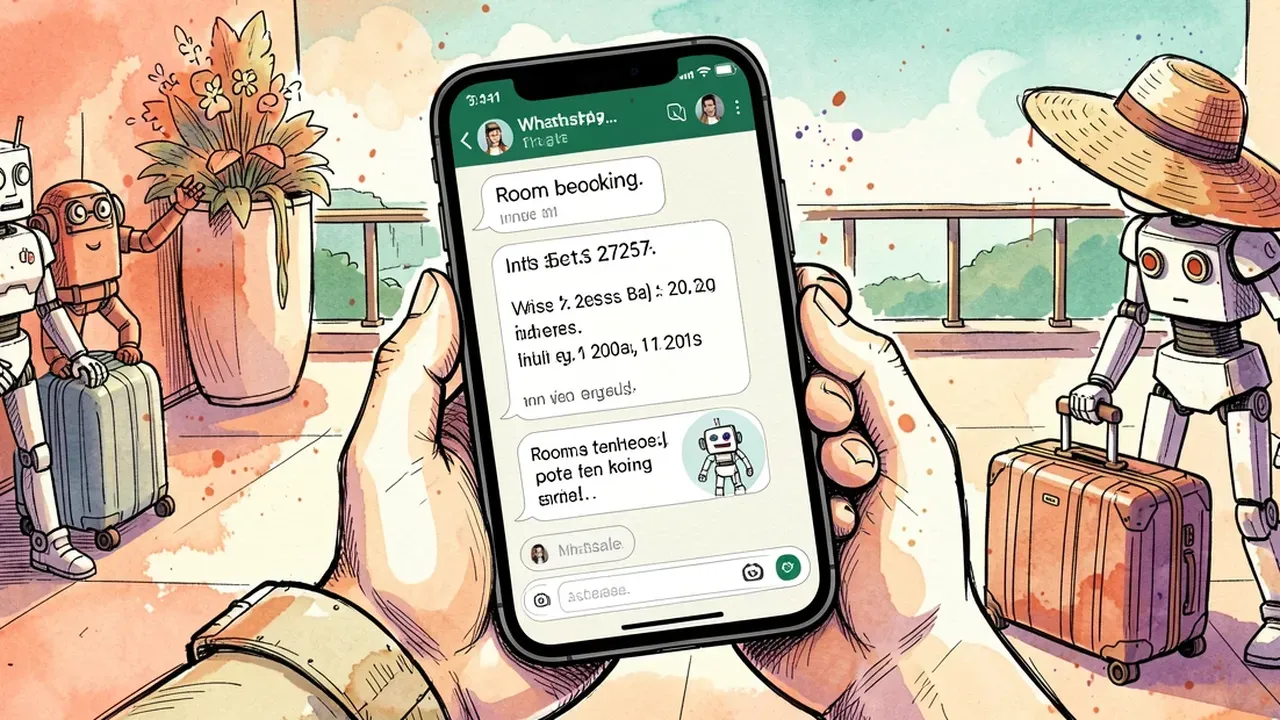
Guided booking. The agent walks through the reservation (check-in date, check-out date, number of guests, room type) and returns a clear summary with total price before confirming, the way a good front-desk agent would over the phone.
Confirmation and house rules. After booking, the agent sends check-in and check-out times, cancellation policy, and answers pet, parking, or breakfast questions without waking anyone up.
Support during the stay. “What time is breakfast?” or “can I get a late check-out?” are everyday questions from guests already on-site. The agent answers with the property’s actual information, without pulling someone off housekeeping or the front desk.
How to build the automated booking flow
The practical path, without a dedicated tech team:
- Upload house rules as a knowledge base. Check-in/check-out times, cancellation policy, amenities, pet policy. The agent only answers with what’s actually there, never inventing a rule the property doesn’t have.
- Define the booking flow. Check-in date → check-out date → number of guests → room type → price confirmation. The agent follows this order in every conversation, at any hour.
- Connect real availability. A confirmed booking needs to reflect on the same calendar the front desk already uses, so two guests never get booked into the same room on the same date.
- Set up the check-in reminder. An automatic message one or two days before arrival, with time, address, and access instructions.
- Define the escalation trigger. Special requests, complaints, or anything off-script (large groups, events, rate negotiation) go straight to a human, with the conversation history attached.
With that running, the front desk only deals with what genuinely needs someone: negotiation, the unexpected, and the in-person welcome no agent can replace.
Cutting no-shows and last-minute cancellations
A no-show hurts more in hospitality than in a restaurant, because an empty room can’t be resold at the last second. An agent attacks this two ways:
- Active confirmation before arrival. An automatic message asking for check-in confirmation one day out, with a reschedule option built right into the conversation if the guest’s plans changed.
- A clear cancellation policy from the start. The agent states the policy at booking time (not later, when the guest disputes a charge they didn’t expect), which cuts down on disputes and chargebacks.
Properties that work with deposits benefit here too: the agent can guide the deposit payment as part of the booking flow itself, without anyone having to call and chase it down afterward.
Dynamic rates: peak season, pricing, and real-time availability
Hotel rates change more than pricing at almost any other consumer-facing business. Weekends cost differently than weekdays, holidays carry their own rate, and a room can go unavailable overnight due to maintenance. An agent working off a static knowledge base, updated once a month, quickly becomes a source of errors.
The right way to handle it:
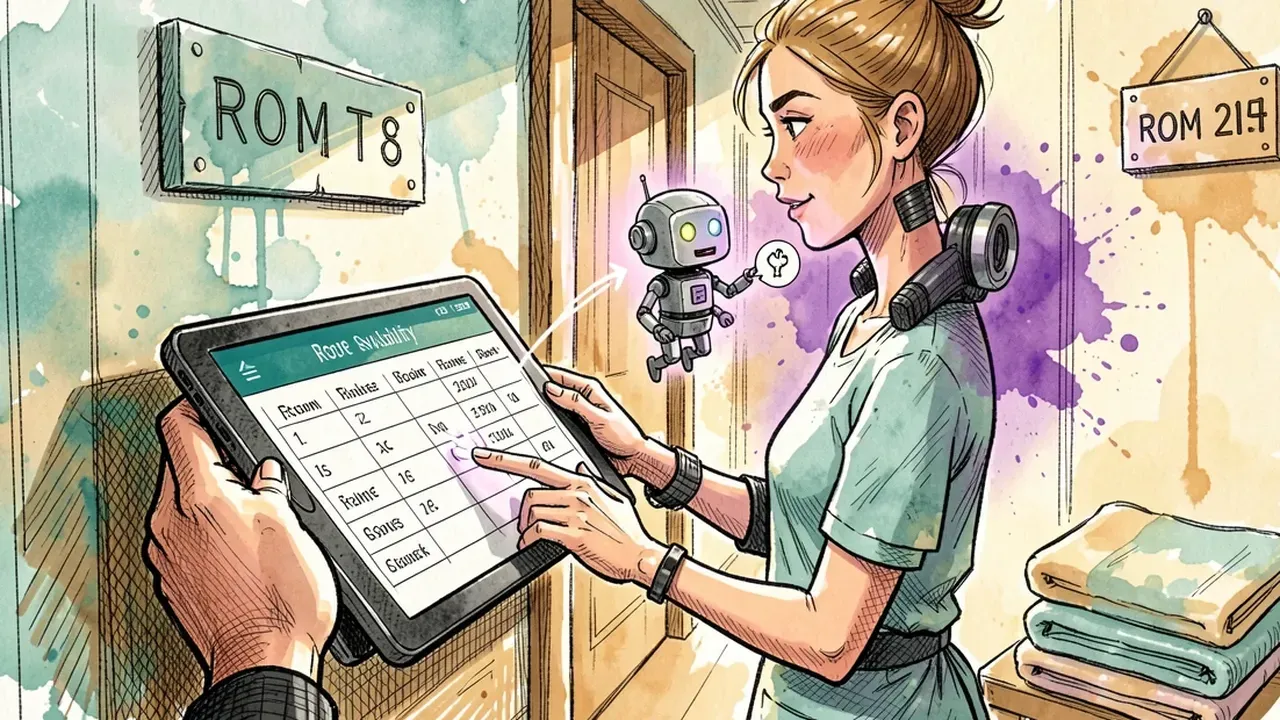
- Mark unavailability on the spot, straight from front desk or housekeeping staff, without relying on someone editing a spreadsheet in a different system.
- Bake rate rules into the knowledge base itself, not just into staff’s memory. A holiday rate needs to be marked as “valid Dec 25-27” in the actual content the agent references.
- Regularly review the questions the agent didn’t answer well. That’s exactly what AutoLearn does: it collects the questions the agent struggled with (a room type it couldn’t describe, an amenity that changed) and suggests the knowledge base update, one click away, for whoever manages it.
That avoids the most frustrating scenario of all: a guest confirms a booking for a room that’s no longer actually available, and someone has to call and unwind a confirmed reservation.
Common mistakes when automating hospitality
Stale availability in the agent’s knowledge base. If a room sold through another channel and the base wasn’t updated, the agent confirms a booking that no longer exists. That breaks trust fast, and in hospitality trust is the product.
A booking flow that’s too rigid. A guest who already knows exactly what they want shouldn’t be forced through six questions before closing. The agent needs to recognize when to skip a step.
No plan for special requests. Large groups, events, guests with specific needs: that’s not something automation should decide alone. Escalate to a human, every time, with the conversation context attached.
Ignoring the guest’s time zone and language. A traveler from another country messages on their own clock. The agent needs to respond fast regardless of what time it is where the property sits, and ideally recognize when the conversation switches to another language.
Real example: an 18-room beach inn
An 18-room beach inn received nearly all of its bookings through WhatsApp and Instagram, handled by one person who also managed in-person check-in. Outside business hours and on weekends (exactly when most people research travel), messages sat unanswered for up to a full day.
With an agent covering availability, guided booking, and house rules, time to first response dropped to seconds at any hour, including the middle of the night. The front-desk staffer shifted focus to group negotiations, special requests, and the in-person check-in itself, which is where the guest experience is actually won or lost.
On the no-show side, the inn had about 12% of confirmed bookings ending in no-shows, especially around long holiday weekends. After the automatic check-in confirmation reminder started running one day before arrival, with a reschedule option built into the message, that number dropped consistently, and the inn stopped losing rooms to phantom bookings that could have been resold in time.
Metrics worth tracking
Time to first response, especially outside business hours and on weekends. It’s the number that most directly affects bookings lost to a competitor.
Booking completion rate. How many booking conversations reach a confirmed price, without the guest dropping off mid-flow.
No-show rate, before and after the automatic check-in reminder went live.
Volume escalated to a human. Shows whether the agent is genuinely resolving repetitive work or just pushing it downstream.
Direct bookings vs. OTA. Comparing the direct channel against OTA commission helps decide where to invest promotion effort: every booking that shifts to direct WhatsApp, commission-free, is worth more than the report line suggests.
None of these metrics need a manual spreadsheet. The support dashboard already shows response time, completion rate, and escalated volume by period, so you can compare before and after automation went live.
One agent, the whole stay
Availability that changes daily, peak-season rates, a guest writing at 11pm from another time zone: all of it calls for an agent that actually knows the property’s real operation, not a generic FAQ bot. SquadOS builds that agent by chatting (no prompt engineering), connects it to WhatsApp with native guardrails, and keeps the rules and availability knowledge base current with AutoLearn, which learns from every real conversation. Start free, no card required.