AI for schools and online course providers: automated enrollment and student support on WhatsApp
How schools, training centers and online course platforms use AI agents on WhatsApp to answer questions, close enrollment and cut dropout without overloading staff.
On this page
- Why schools and course providers live on WhatsApp
- What an AI agent actually handles
- How to set up an automated enrollment flow
- Dropout: the agent that notices a student going quiet
- Common mistakes when automating school support
- Real-world example: a language school with 400 students
- Metrics worth tracking
- One agent, the whole student journey
At the start of every month, a language school’s front desk gets the same flood of messages: “did my invoice arrive?”, “can I make up Tuesday’s class?”, “what time is the advanced English group?”. Multiply that by enrollment season in January and again in July, add students asking about certificates right before a job interview, and the front desk turns into an improvised call center, answered off someone’s personal phone. Online course platforms feel the same pain under a different name: a student gets stuck on a lesson and messages support at 10pm, with nobody there to answer until the next day.
Why schools and course providers live on WhatsApp
Unlike an e-commerce store, where message volume stays fairly steady through the month, schools and course platforms see demand spike in predictable waves:
- Enrollment periods (new semester, new cohort launch), when “how much does it cost”, “is there a spot open” and “how do I sign up” pile up week over week.
- The start of each month, when invoices go out and the front desk turns into informal billing support: reissued invoices, due dates, early-payment discounts.
- The day before a test or deadline, when students want to confirm the room, allowed materials or the submission window, all at once.
- The end of a course, when everyone asks for a certificate, an enrollment letter or a transcript on the same day.
None of these spikes is unpredictable. They repeat every month, every semester. The problem is most institutions still treat each spike as an emergency handled on the fly, instead of a flow that should already be automated.
What an AI agent actually handles
An agent connected to the institution’s WhatsApp covers what’s repetitive and lookup-based, freeing staff for what genuinely needs a human judgment call:
Guided enrollment. A prospect asks about a class and the agent walks the conversation forward (course, schedule, payment method, required documents) until enrollment is ready to confirm, the way a good front-desk person would in person.
First-line billing. Reissuing an invoice, checking a due date, explaining an early-payment or referral discount: information that lives in the knowledge base and doesn’t need to route through a person.
Make-up classes and schedules. “I missed Tuesday’s class, is there a make-up session?” is a question that repeats weekly at any school with recurring classes. The agent checks the real schedule and answers instantly, no one needs to open a spreadsheet.
Certificates and enrollment letters. Near the end of a course, or around job-interview season, requests for enrollment letters and certificates spike. The agent confirms the student’s details and routes the request for issuance, no multi-day queue.

How to set up an automated enrollment flow
The practical path, without needing a dedicated technical team:
- Load the course catalog as a knowledge base. Course, schedule, hours, price, open seats. The agent only answers with what’s there, it never invents a class that doesn’t exist.
- Define the enrollment flow. Course of interest → schedule → payment method → documentation → confirmation. The agent follows this order in every conversation, at any hour.
- Connect billing. Reissued invoices and payment status need to come from the real system, not a table someone forgot to update.
- Set up the make-up class calendar. The class schedule and available make-up slots stay accessible to the agent, kept current alongside the academic coordination team.
- Define the escalation trigger. Complaints, discount negotiations, sensitive academic cases (a struggling student, a conflict with a teacher): those go straight to a human, with the full conversation history attached.
With that running, front-desk staff only handle what genuinely needs a person: negotiation, exceptions, and the academic follow-up no agent can replace.
It’s worth connecting the agent to whatever school management system the institution already runs (an SIS or LMS, depending on the case), instead of keeping a second source of truth just for the AI. A full class, a paid invoice, a make-up class already booked: if that information already lives in a system, the agent should check it there, not in a copy someone forgets to update. And because the same agent covers WhatsApp, Telegram and the website chat off one knowledge base, families can pick whichever channel they prefer without getting a different answer on each one.
Dropout: the agent that notices a student going quiet
Dropout is the problem most schools only catch late, once the student has already stopped responding and tuition has stopped coming in. An AI agent helps on two fronts that usually depend on someone remembering to check manually:
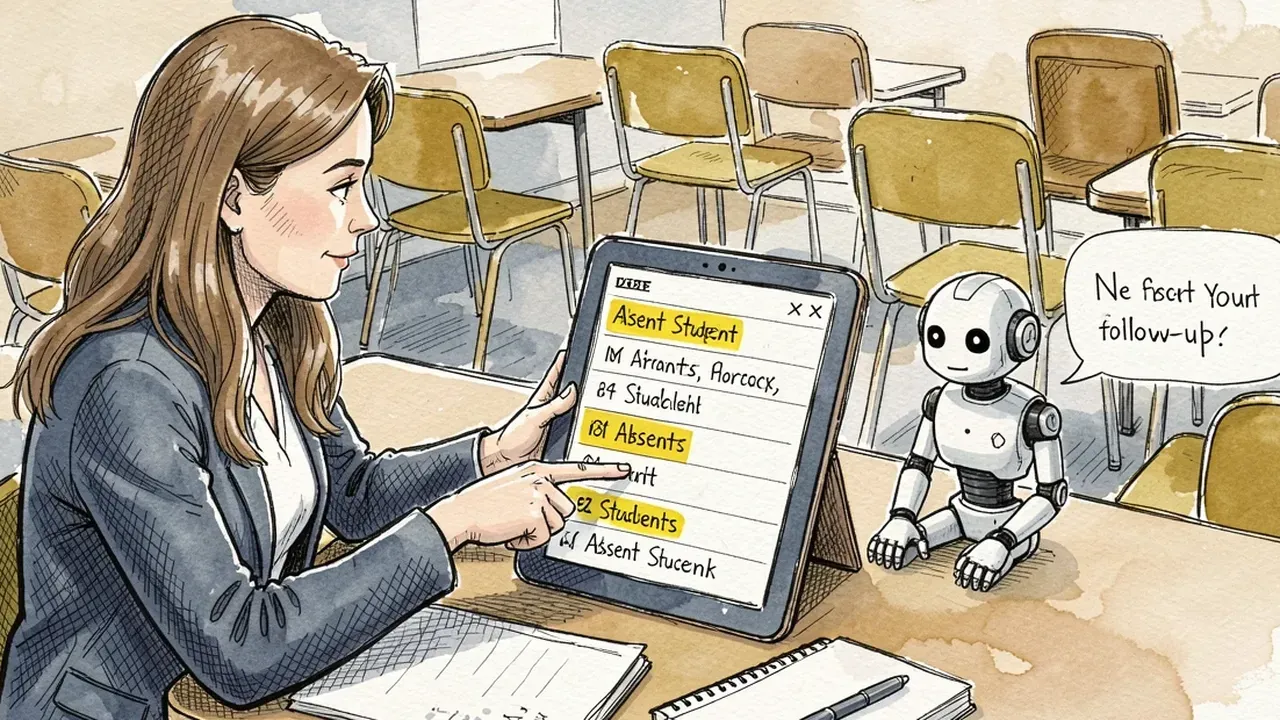
- Consecutive-absence follow-up. A student who misses two or three classes in a row gets an automatic check-in message offering a make-up session, before the gap turns into a silent dropout.
- Re-engagement for stalled online courses. In a self-paced course, a student who hasn’t opened a lesson in two weeks is a risk signal. A simple “pick up where you left off” message recovers part of that group before they forget they even enrolled.
Neither trigger requires a person checking an attendance spreadsheet every day. It’s the kind of task that only actually happens once it’s automated, because manually it always loses to whatever feels more urgent that day.
Common mistakes when automating school support
Outdated class catalog. If a class fills up and the base isn’t updated, the agent confirms enrollment into a seat that no longer exists. That creates rework and frustrates someone who already thought they were in.
A flow too rigid for people who already know what they want. A student who’s already decided on a course and just wants to confirm the schedule shouldn’t have to answer six qualifying questions before getting there.
No plan for academic edge cases. Learning difficulties, a conflict between a student and a teacher, a cancellation request over dissatisfaction: automation shouldn’t decide those alone. Always escalate to a human, with the conversation context attached.
Ignoring the parent and guardian audience. In children’s or K-12 programs, it’s the guardian messaging in, not the student. Tone and the type of information (report cards, meetings, pickup authorization) need to account for that different audience.
A knowledge base frozen in time. A schedule that changes every semester, a new teacher, a discount policy that got revised: if nobody updates the base, the agent repeats stale information with the same confidence as correct information. Reviewing the questions the agent handled poorly is the fastest way to catch those blind spots before they turn into complaints.
Real-world example: a language school with 400 students
A language school with around 400 active students handled most enrollment and billing questions on WhatsApp through a single staff member, who also covered the front desk in person. During semester enrollment periods, message volume tripled and response time stretched to a full day, which pushed some prospects to enroll at a competing school that replied first.
With an agent covering guided enrollment, invoice reissuing and make-up scheduling, time to first response dropped to a few seconds at any hour. The staff member shifted focus to scholarship negotiations, academic edge cases and the in-person interactions that actually need a human.
On the dropout side, the school had roughly 18% of students disappear without formally canceling, simply stopping attendance after two or three missed classes nobody caught in time. With automated consecutive-absence follow-up running, part of that group came back after receiving the make-up-class message, and the school gained real visibility into who was at risk before it turned into a cancellation.
Metrics worth tracking
Time to first response, especially during enrollment periods and the first weeks of each month when invoices go out.
Enrollment completion rate. How many enrollment conversations reach confirmation, without the prospect dropping off mid-flow.
Dropout rate, before and after automated consecutive-absence follow-up goes live.
Volume escalated to humans. Shows whether the agent is genuinely resolving the repetitive stuff or just pushing work downstream.
Certificate and letter turnaround time. The faster this process runs, the fewer complaints show up right before an interview deadline or another application.
None of these metrics need a manual spreadsheet. The support dashboard already shows response time, completion rate and escalated volume by period, so you can compare before and after automation goes live.
One agent, the whole student journey
Enrollment spikes in January and July, invoices hitting every month, students going quiet without a word: all of it calls for an agent that knows the institution’s real calendar, not a generic FAQ bot. SquadOS builds that agent by chatting, no prompt engineering required, connects it to WhatsApp with native guardrails, and covers external support from the prospect who hasn’t enrolled yet to the student already mid-course. Start free, no credit card.